Pressure Controls in Refrigeration: A Complete Guide to Operation, Selection, and Troubleshooting
14/10/2026 · 108 مشاهدة
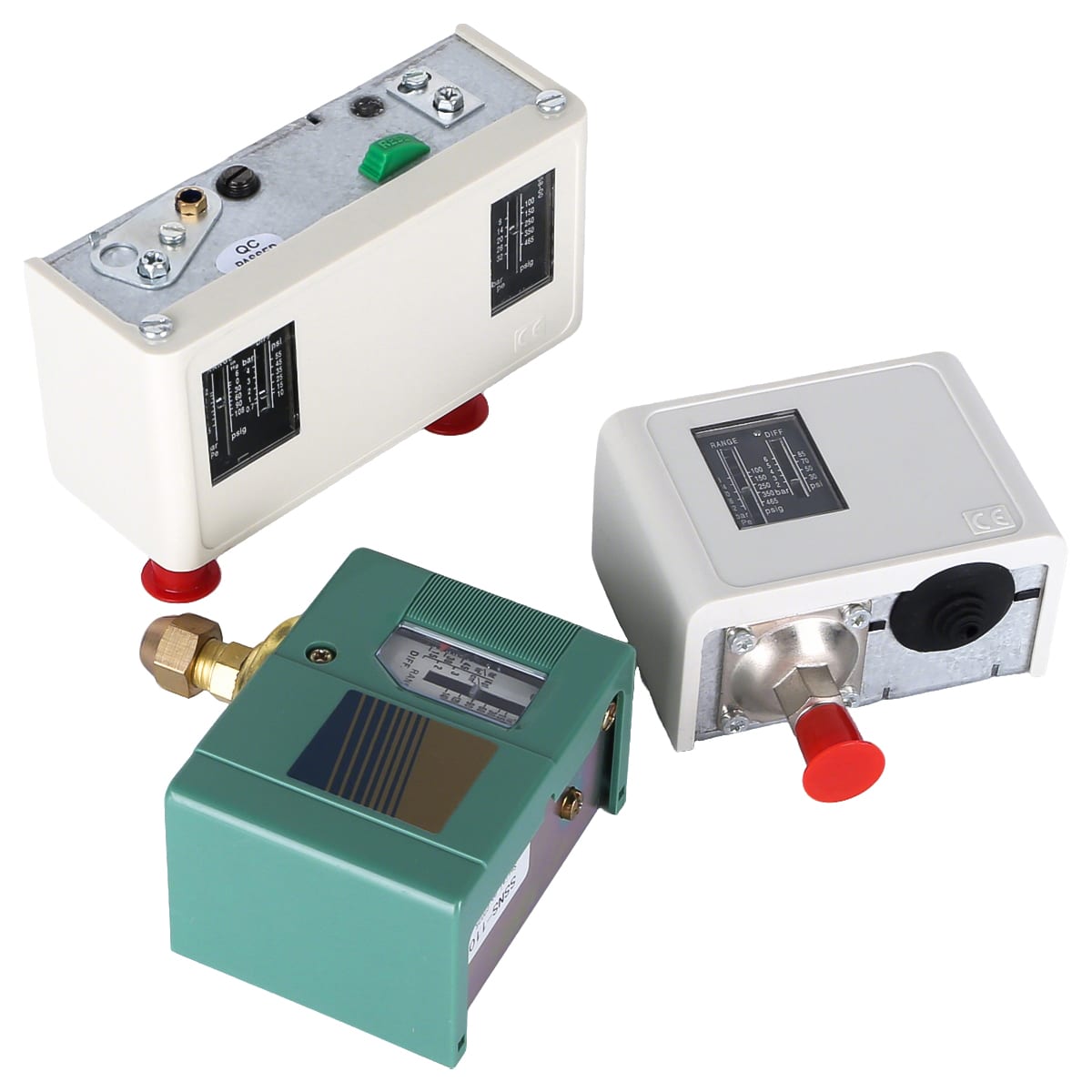
Pressure controls are the primary protective devices in refrigeration and air conditioning systems. They monitor suction and discharge pressures to cycle compressors on and off, preventing low-pressure failure and high-pressure overload. This guide explains how pressure controls work, the difference between single and dual pressure switches, how to set key parameters, and how to diagnose common faults.
What Is a Refrigeration Pressure Control?
A refrigeration pressure control is an automatic device that monitors pressure changes in a refrigeration system and controls the compressor based on preset values. Its core function is to protect the compressor from damage under abnormal operating conditions—whether from insufficient refrigerant return caused by low suction pressure, or from overload caused by excessive discharge pressure.
In a typical refrigeration cycle, the compressor raises refrigerant from the low-pressure side to the high-pressure side. The refrigerant then rejects heat and condenses in the condenser, passes through an expansion valve where it is throttled to a lower pressure, evaporates in the evaporator while absorbing heat, and finally returns to the compressor suction. Pressure controls are typically installed on both the low side (between evaporator and compressor) and the high side (between compressor and condenser), monitoring these two critical points.
Unlike a simple pressure gauge, a pressure control does not just sense pressure—it acts on it. Through internal switch contacts, it opens or closes the compressor control circuit, providing automatic protection.
How Does a Pressure Control Work?
The sensing element in most pressure controls is a bellows or diaphragm. When refrigerant pressure acts on the diaphragm, it produces displacement. This movement is transmitted through a mechanical linkage to switch contacts, which open or close the electrical circuit.
Low-Pressure Protection Logic
The low-pressure switch monitors pressure on the compressor suction side. When suction pressure drops below a set cut-out point (for example, around 4 psi), the switch opens and the compressor stops. This prevents the compressor from running under vacuum or with insufficient refrigerant, conditions that can cause poor lubrication and compressor damage.
The low-pressure switch typically closes automatically once pressure rises to a preset reset value, allowing the compressor to restart. The difference between the cut-out pressure and the cut-in pressure is called the differential or deadband. This differential prevents the compressor from short-cycling when pressure hovers near the trip point.
High-Pressure Protection Logic
The high-pressure switch monitors pressure on the compressor discharge side. When discharge pressure exceeds a safe upper limit (for example, 400 psi), the switch trips and cuts power to the compressor. High-pressure protection is usually a manual-reset type, meaning the system must be inspected and the switch reset by hand after the fault is cleared. This prevents the compressor from repeatedly restarting before the underlying problem is resolved.
Some high-pressure protection designs take a more extreme approach. In certain patented configurations, when pressure reaches a very high threshold (such as 550 psig), a specially positioned pin punctures the diaphragm, venting high-pressure refrigerant directly to atmosphere to prevent system rupture.
Single vs. Dual Pressure Controls
Refrigeration pressure controls fall into two main categories:
Single pressure controls monitor only one pressure point. They are used for refrigerated dryers, condenser fan cycling, or small compressor protection where only one protection function is needed. In a refrigerated dryer, for example, a single pressure control monitors line pressure, stopping the fan when pressure drops to 14 bar to prevent over-cooling and restarting it when pressure recovers to 16 bar.
Dual pressure controls integrate both low-pressure and high-pressure monitoring channels in one unit, providing suction-side low-pressure protection and discharge-side high-pressure protection simultaneously. This is the standard configuration for commercial refrigeration systems and large cold storage facilities. Dual controls are further classified by reset method: low-side automatic reset with high-side automatic reset, and low-side automatic reset with high-side manual reset. The latter offers a higher safety level and is preferred for high-pressure, high-risk applications.
Key Parameter Settings
Correct parameter settings are essential for reliable system operation. The following are the core settings:
Cut-Out and Cut-In Pressure
Cut-out pressure is the value at which the control trips and stops the compressor. Cut-in pressure is the value at which the control allows the compressor to restart. The difference between them is the differential.
Settings should follow the refrigeration equipment manufacturer's recommendations for the specific refrigerant and minimum ambient temperature. Too small a differential causes frequent compressor cycling. Too large a differential may allow the system to operate under abnormal conditions without protection.
Low Ambient Safety Pressure (LAS)
In cold environments, suction pressure during system startup may temporarily fall below the normal cut-out value. The low ambient safety pressure setting should be lower than the low-pressure cut-out, allowing suction pressure to dip briefly during startup without falsely tripping the protection.
Anti-Short-Cycle Delay
Some control systems include a cut-in delay function, requiring a preset time to elapse after compressor shutdown before restart is permitted. This prevents short cycling caused by rapid pressure fluctuations and protects the motor and contactor.
Common Faults and Diagnostic Approach
Pressure control faults typically appear as abnormal compressor cycling or complete failure to start. Modern refrigeration controllers can pinpoint the fault source by analyzing compressor run time and current characteristics.
Distinguishing low-pressure from high-pressure faults: The controller monitors the ratio of compressor running current to baseline current. When the current ratio exceeds approximately 1.4, it typically indicates a high-side fault. When the ratio falls below approximately 1.1, it indicates a low-side fault.
Distinguishing switch trip from motor protector trip: If compressor downtime is shorter than about 7 minutes, the cause is usually a pressure switch cycling. If downtime exceeds 7 minutes, the motor protector has likely tripped.
Common causes of low-pressure switch tripping: Undercharged refrigerant, insufficient evaporator airflow, restricted expansion valve or filter drier, dirty condenser, or insufficient subcooling. All of these produce abnormally low suction pressure and trigger low-pressure protection.
Common causes of high-pressure switch tripping: Poor condenser heat rejection (dirty coil, fan failure), overcharged refrigerant, non-condensable gases such as air in the system, or excessively high ambient temperature.
Selection Guidelines
When choosing a refrigeration pressure control, consider the following factors:
Match the control type to the application: Use a single pressure control for single-function equipment such as refrigerated dryer fan cycling. Use a dual pressure control for compressor systems requiring full high and low pressure protection. For high-pressure, high-risk applications, prioritize dual controls with manual reset on the high side.
Match operating parameters: Select the range according to refrigerant type and system rated working pressure. A mismatched range will either defeat protection or cause frequent unit cycling.
Match the protection rating: Industrial refrigeration environments generally require IP44 or higher protection to withstand moisture and dust.
Frequently Asked Questions
What is the difference between a pressure control and a pressure switch?
The terms are often used interchangeably in refrigeration. Technically, a pressure switch is the switching element, while a pressure control includes the switch plus the sensing element, housing, and adjustment mechanism. In practice, both refer to the same protective device.
Can I adjust pressure control settings in the field?
Yes, most mechanical pressure controls have adjustable range and differential screws. However, settings should always follow the equipment manufacturer's specifications. Incorrect settings can void warranties and cause compressor failure.
Why does my compressor short-cycle?
Short cycling is usually caused by a differential set too narrow, a refrigerant charge issue, or a restriction in the system. Check the pressure control differential first, then verify refrigerant charge and system components.
How often should pressure controls be tested?
Pressure controls should be function-tested during routine preventive maintenance—typically annually for commercial systems, or more frequently for critical applications. Testing involves manually tripping the switch or verifying cut-out and cut-in pressures against specifications.
Conclusion
Pressure controls are small components with a critical role. They are the primary defense protecting compressors from low-pressure and high-pressure damage in refrigeration systems. Understanding how they work, setting parameters correctly, and being able to diagnose fault sources quickly are essential skills for anyone designing, installing, or servicing refrigeration equipment. Whether the application is a commercial display case, a central air conditioning system, or a large cold storage facility, selecting the right pressure control and commissioning it properly is fundamental to compressor longevity and reliable system operation.